
Symbols in Jungian Art: Why Connecting with Them Is So Crucial
Jan 17, 2026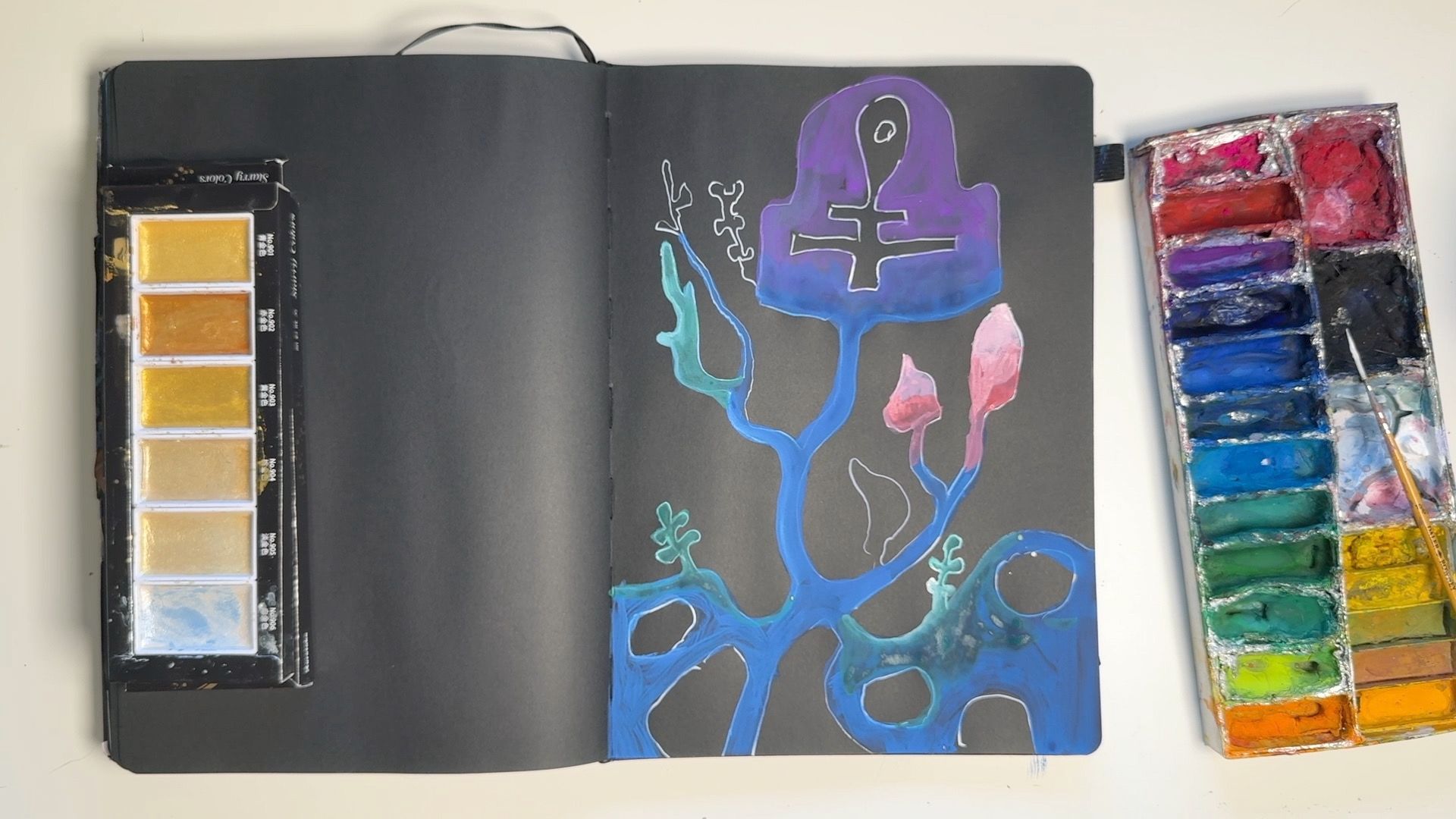
Carl Jung believed that to be able to live a symbolic life, that is to be able to be in contact with inner symbols for example through dreams and art, is the prerequisite of a psychologically healthy life. The ultimate goal of Jungian work therefore is to make the symbolic process conscious and in Jungian art we do that in a very concrete and visual way through images. In this post I will go over what symbols are exactly and why are they so important.
A symbol is essentially a carrier of psychic energy - it makes visible through an image something that is emotional, and often also spiritual in nature . So for example you might have a dream where you’re walking in the dark forest during the night an you see an owl. There we already have many symbols: darkness, owl, night and forest. I work with people examining their inner symbols not only through dreams but mainly through images that we make by for example drawing painting and collage. So when we surrender to a process of making these images that is unplanned, intuitive, and spontaneous we can start to track the realm of symbols that is constantly moving in out psyche.
If you're interested in how this process works concretely, I have a free guidebook available for download which takes you on a step-by-step process on how to uncover and connect with your inner symbol. It's available here.
So the thing about symbols is that they remain partly unknown and Jung even said that a symbol is "the announcement of something unknown." If we were to know exactly what a symbol means then it would stop being a symbol and it would become a sign.
For example, if you see a cross on a map, you would know that it probably points to a church at that location. But if you see that same cross inside of a church, you would not be able to pin the meaning of it into any definitive thing. It can signify many different things to different people. So on the map the cross would be a sign and the cross inside of the church would be a symbol. Jung said that “a sign is always less than a thing that it points to and a symbol is always more than we can understand at first sight”.
This differentiation between a symbol and a sign is good to keep in mind mainly because it helps to understand a certain kind of attitude when examining the imagery that appears in our dreams or through our art. When I work with people and we’re examining this imagery, we are not trying to decode the elements of them by thinking of them as signs but by seeing them as symbols. Jung said that "Whether a thing is a symbol or not depends chiefly upon the attitude of the observing consciousness." To look at our dreams and images with a symbolic mindset is to look at them with the attitude of not knowing.
Our psyche is constantly producing a stream of symbolic images. usually we only notice this stream of imagery in our dreams when our consciousness is lowered. However, this stream of energy that the symbols carry does not stop in our waking life, it just goes unnoticed by the ego, that is, by our consciousness. These symbols have a huge effect on our life even if, or especially if, we don't consciously pay attention and connect with them.
This is why it can be really important to engage in some sort of creative process - because through these kind of creative processes we are able to connect with this realm of symbols in a more conscious way. Because in our dreams we really are just passive viewers of that realm. In art making however, we are able to connect with those images in a more conscious state and be in a more active relationship and dialogue with them. That being said, we can not manufacture symbols ourselves but rather we discover them. Still, a certain space has to be constellated for that discovery to happen.
On the other hand, if we are not connected to those images, if we disregard our dreams or we start viewing the world through the lens of signs, then we start to live the symbols out unconsciously. We live them out through projections in the outside world in ways which often cause us guilt, shame, and pain. For example, these could be through obsessions, addictions, or in any situations where we’re overtaken by strong emotions.
When we work in a conscious way with those symbols we are allowing that energy to be transformed and we free ourselves from the pressure of unconscious contents. Instead of the symbol being carried through pain it becomes an image that carries meaning. Jung believed that behind every symptom there is always an image that carries meaning
I think that especially in this time that we are living, where are bombarded with images online and in social media, and we are viewing images that rarely have a personal connection or meaning to us, then it becomes even more important and critical for us to have ways in which to stay in touch with the inner images within us.
Another reason that makes symbols especially important in our time today is that they are always associated with emotion and they often contain a numinosity, something mysterious. The scientific worldview that is so dominant today, and was dominant in Jung's time already, has made it so that we have lost the worldview that life contains a mysterious aspect. But it is that inner mystery which also connects us to the depth of life. I'm sure many of us have experienced this through seeing a dream that was so powerful that we remember it for the rest of our lives.
If you feel drawn to explore the depth of your creative potential, I invite you to join me inside Unveiling the Unconscious. This online Jungian art program offers a guided path into the creative unconscious through direct hands-on experience and includes lots of personal guidance.
Stay connected:
Join my mailing list to receive news and updates.