
5 Ways to Paint Dreams - Prompts for Visual Dream Journaling
Sep 12, 2026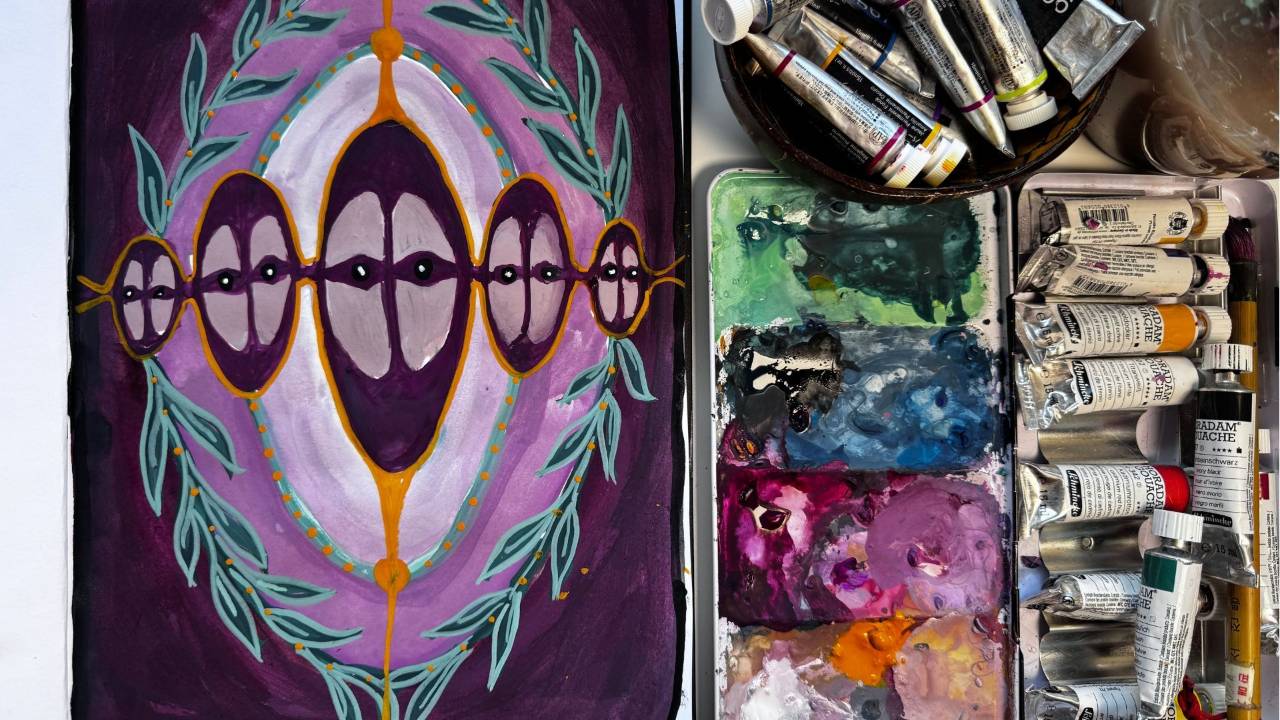
5 Ways to Paint Dreams
“Lack of conscious understanding does not mean that the dream has no effect at all… Dreams can be ‘understood’ to a certain extent in a subliminal way, and that is mostly how they work.”
— Carl Jung
Introduction
Dreams speak to us through images, symbols, metaphors and feelings. They rarely communicate in the clear and rational language of waking consciousness.
From a Jungian perspective, a dream is not something that we can simply explain rationally. Rather, it is something to enter into relationship with. Jung believed that what is essential about dreams is that they have a living effect on us. He wrote:
“Naturally a new meaning does not come ready-made out of the unconscious… a living effect is achieved only when the products of the unconscious are brought into serious relationship with the conscious mind.”
— Carl Jung
Painting our dreams is a way to cultivate that “living effect.” Art allows us to remain close to the dream’s original language. The images we make from our dreams do not have to duplicate the dream. When we create an image of a dream, we allow its energy to move forward in some way—and this is an essential step.
In this post, I will walk you through five different ways you can make images from your dreams. These prompts are intended to help your unconscious continue working through the dream and support you in entering into a richer communication with the dream realm. These are especially useful if you would like to start keeping a visual dream journal.
Prompt 1. Moods and Feelings
In this exercise, you will return to the feeling atmosphere of a dream and create an image that portrays this feeling rather than the literal details of the dream.
Choose a recent dream that contains a strong feeling, emotion or atmosphere. The dream does not need to contain many details. It is enough that you can connect with its major feeling.
Find a place where you can be undisturbed and take a moment to connect with your body. Close your eyes and gently return to the dream. Notice how the feeling of the dream feels now. What do you smell, hear, see or feel? How do you experience the dream and its atmosphere in your body?
Once you have established a good connection with the feeling atmosphere of the dream, begin making an image that portrays it. Instead of illustrating the details of the dream, use colours, shapes, symbols and textures that you associate with its feeling. Paint can be especially expressive for this exercise, but you can use any materials you feel drawn to. Allow the image to be true to the feeling rather than focusing on how it looks.
Prompt 2: Dream Figures
Begin by creating an image that brings together all the different characters from your dream, including yourself. Use any materials you prefer. The figures in your artwork do not need to look exactly as they did in the dream—allow yourself the freedom to explore shapes, colours, lines and textures that capture their essence.
Once your image is complete, take a moment to observe how you have positioned the characters in relation to one another. Then, step into the image and embody each character’s perspective. Imagine the dream as a film that you can replay in your mind, but this time, instead of experiencing it as yourself, fully inhabit the role of another character.
See the dream unfold through their eyes. What does it feel like to be them? What do they see? What emotions and thoughts arise? How do they perceive their interactions with your dream ego?
Afterwards, write down the story from this character’s point of view, along with any insights that emerge. Think about how these perspectives relate to your own life. Do they complement, contradict or confirm something in your life?
Prompt 3: Quintessence and Polarity
The quintessence is the essential nature of a dream—the quality that remains when everything unnecessary falls away. It is not necessarily the dream’s message or final meaning. Rather, it is the innermost atmosphere or energy that seems to live at its centre.
Dreams also frequently communicate through polarity. They may place light beside darkness, safety beside danger, closeness beside distance or movement beside stillness. These opposites may reflect a tension within us or compensate for a perspective that has become too one-sided in waking life. The purpose is not always to choose one side over the other, but to become more conscious of the relationship between them.
Exercise: Give Form to the Essential Tension
Return to your dream and ask: If everything unnecessary fell away, what essential quality would remain? Allow a word, colour, texture, shape or bodily sensation to arise. Paint this quality somewhere on your page.
Then ask yourself what opposite quality is also present, implied or missing. For example, the image may contain vulnerability and strength, freedom and confinement, order and chaos, or something known and something unknown.
Add this opposing quality to the image. Notice where you place it, how large it becomes and whether the two forms move towards or away from one another. Let their relationship develop without forcing it.
When the image feels complete, reflect on the following questions:
-
What is the essential quality at the heart of this dream?
-
Which side of the polarity feels more familiar or conscious to me?
-
Which side feels distant, rejected or difficult to understand?
-
Is one quality dominating while the other remains hidden?
-
What might the less familiar side bring into my life?
-
What becomes possible when both qualities are allowed to exist?
Prompt 4: Symbols
A symbol is an expression of something unknown. If we could completely unravel its meaning, it would no longer be a symbol but a sign. Symbols carry many layers of meaning, and this exercise will help you explore the personal, cultural or biological, and collective or archetypal levels of a symbol.
Step 1. Choose and Portray Your Symbol
Choose a symbol from your dream. Draw or paint it without looking at reference images first. Let go of aesthetics and trust that the same wisdom of the unconscious that brought the symbol to you can also carry the image forward.
As you work, notice how you portray the symbol. What feeling does it carry? For example, does it appear gentle, threatening, distant or inviting? Your image may already reveal something about your relationship with it.
Step 2. Explore the Personal Level
Write down your personal associations with the symbol, including any memories, experiences and feelings connected with it. The feeling tone of the symbol is often the best place to begin because it can reveal how the symbol relates to your individual history. Always return to the original symbol rather than following a chain of associations.
Step 3. Explore the Cultural or Biological Level
Imagine that you are describing the symbol to an alien who knows nothing about life on Earth. What is it? What does it look like, what does it do and what is it used for? If it is a person, describe their role and qualities. If it is an animal, explore its biology, behaviour and natural environment.
Notice whether any of these qualities seem to click or connect with something happening in your life at the moment.
Step 4. Explore the Collective or Archetypal Level
Research how the symbol appears in mythology, religion, fairy tales, art and other cultures. Jung called this process amplification. Look for recurring stories, themes and patterns associated with the symbol rather than searching for one fixed definition. You may find many possible meanings, but pay attention to what feels right or comes alive for you.
Prompt 5. Dreaming the Dream Forward
In this exercise, we take a dream image as a starting point and dream it forward through active imagination. We then paint an image from our experience.
Step 1: Choose a Dream Scene
Recall a dream and choose an image that feels especially important. This is usually the moment from the dream that holds the most energy. Close your eyes and return to its atmosphere and surroundings.
Step 2: Active Imagination
Hold the image in your mind’s eye and wait to see whether it begins to change or develop. A figure might speak, something new may appear or the scene may continue its story in some way. Try not to direct the experience consciously or force anything. Allow it to unfold naturally.
Step 3: Paint Your Experience
When the experience comes to a natural end, create an image of what emerged. If nothing happens, that is completely okay—simply remain with the image for a while and return to the exercise another time if you wish.
Ready to Go Deeper?
If you would like to explore this process in a guided group setting, I warmly invite you to join my online program.
Stay connected:
Join my mailing list to receive news and updates.