
What is Jungian Art? - A Short Introduction
Feb 10, 2026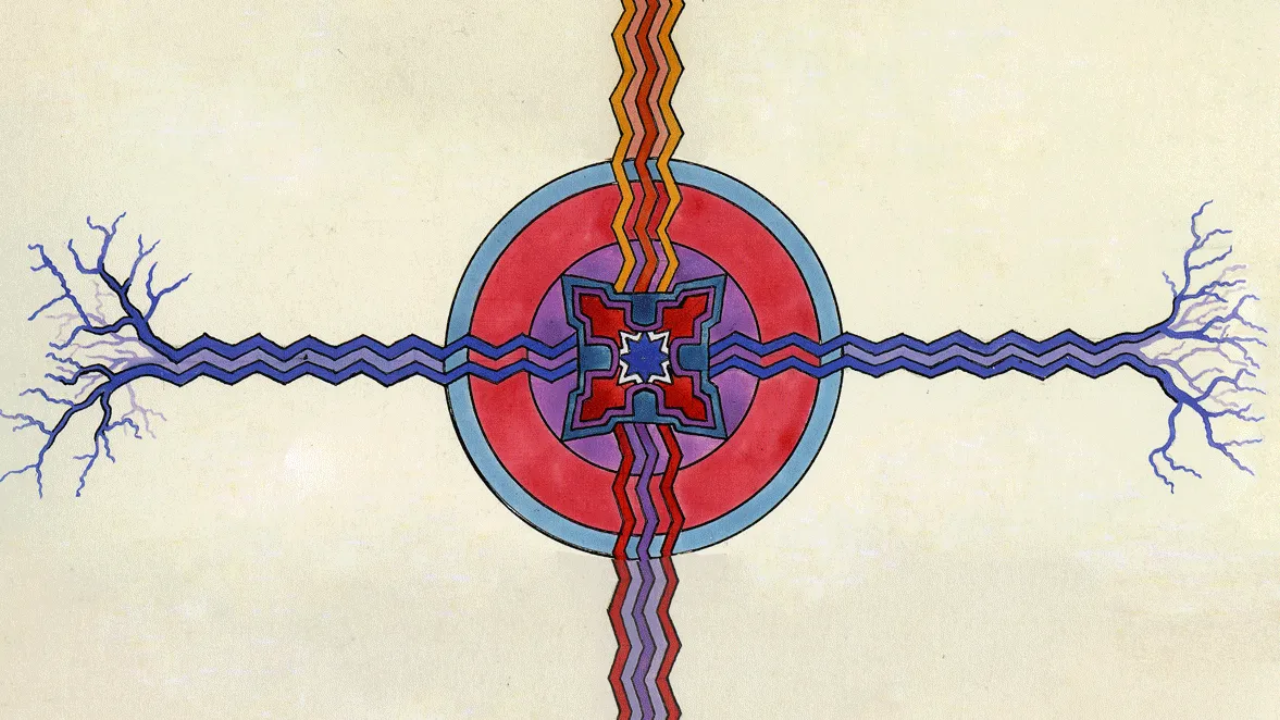
In this short introduction to Jungian art I will discuss how working with creative processes such as painting and drawing can help to engage with the unconscious, how working in this symbolic way is crucial, and how the attitude that we hold towards this work holds such a vital role. I've also included a few perspectives from the people I've worked with on how they've experienced this process.
The Role of the Unconscious in Jungian Psychology
The central aspect of Jungian psychology, or analytical psychology, is firstly the idea that our psyche consists not only of what we are conscious of, but also of a part that we are not conscious of—the unconscious. So in the shadow of our psyche, there are aspects of ourselves which, for one reason or another, we have repressed or disowned.
Secondly, in Jungian psychology, lies the core idea that in this unconscious there are very important qualities and it's vital that we attempt to connect with those qualities. To understand the unconscious and to begin building a relationship with it is to regain those unconscious aspects of ourselves, which are essentially strengths. They are like treasures.
The process of building a relationship with the unconscious is not always pleasant. It does not always bring about a desired outcome, and it can bring up a lot of resistance, because there may be things there that we do not want to know or see about ourselves. But the reward of looking into the darkness of the psyche is that it allows us to become whole. It allows us to become who we truly are—our authentic selves. This process of becoming whole and becoming ourselves, Jung termed individuation, which is a lifelong process.
The process of individuation is rooted in the acceptance of all parts of ourselves, including the darker aspects—the darker tones within us. We do not try to get rid of anything or fix anything about ourselves. Instead, we move toward these parts and integrate them. In this way, the darkness can become our greatest strength.
An Attitude of Acceptance
When we work with creative processes and art making, this attitude of acceptance is important to carry into that. There will likely be moments in the creative process where you feel frustrated, or where parts of your work feel uncomfortable or not “right.” But often, it is exactly those parts that hold the greatest potential. The Persian poet Rumi said beautifully, “The wound is the place where the light enters you.” This is why I always encourage my clients to approach this process with acceptance and gentleness toward themselves. The images that arise will carry their own wounds, and we attempt to respect and be in the presence of that.
When I work with people and we reach that space of curiosity, acceptance and openness I find that it helps people to relax into the art making, and to feel more ease towards their self expression and creativity. My clients have described it like this:
"I found that instead of being concerned with the outward product, I was learning more about what is my thinking process and what is the transformation that's happening as I am creating art and images."
"I have really relaxed into my artwork now by using intuition and imagination- it’s given me access to something that was previously hidden."
"(I now have) a lot of courage to begin expressing myself fully and bravely without so much fear as to how other might respond"
It is when we find this place of acceptance and non-judgement towards our selves and our own creativity that art making becomes a tool for reaching and communicating with the deeper unknown layers of the psyche.
Opening to the symbolic language of the Unconscious
Jung saw the unconscious as having many layers—not only a personal unconscious, but also a collective unconscious. The unconscious has its own way of communicating. It does not speak the language of the conscious mind, and so to become more connected to it, it is important to learn its language. Art, dreams, and myths are ways of speaking this symbolic and metaphoric language and it is why we use them in Jungian art.
The unconscious is difficult to define because it is, in a way, like describing the absence of something. In the same way that in the physical world we have things like air or gravity—forces that are invisible but have a powerful influence on us—the unconscious influences us in a similarly invisible way. Because of this, Jungian work requires a certain openness—a willingness to allow what is unseen, unknown, or mysterious to unfold. This allows us open up a form up communication with a deeper unknown part of the psyche.
Jung believed that the psyche has an inherent capacity for healing. It is constantly striving toward wholeness and balance. Each of us carries this within us, but we must be willing to attend to it, to sit with it, and to be present with it. The psyche also has its own timing. This work requires a kind of surrender to a process that unfolds from within.
Images and the Numinous
Images were central to Jung’s work. He engaged with them deeply in his own life and also in his work with patients. He even went so far as to say that “the psyche is image.” By this, he did not mean only visual images, but a broader, more holistic understanding—something that includes all forms of perception and knowing through the senses.
The images that arise in Jungian art can be seen as sacred expressions emerging from the depths of the psyche. Rather than analyzing or defining them too quickly, we remain present with them. The term circumambulation, which means to move around something in a circular way, captures this approach well. Jung wrote:
“At first, the process is chaotic and interminable, and only gradually do we realize that our path is leading somewhere. The way is not straight, but appears to go in circles or spirals. The whole process revolves around a center… The dreams rotate or circumambulate around this center, drawing closer to it over time.” - C:G.Jung
Often, this process does not end when the art-making ends. The images continue to live within us and unfold over time. Jungian art is not about creating finished pieces or focusing on aesthetics, but about building a relationship with the images and approaching them with curiosity—listening to what they may have to say. In essence it is about attending to the soul. Jungian psychology is deeply connected to the spiritual dimension of life.
Jung himself was interested in alchemy, astrology, and esoteric traditions, although he often kept these interests private due to his professional position. He used the word numinous to describe this deeply meaningful, almost sacred quality of experience. When we come into contact with something numinous, we feel it. If we try to reduce it to intellectual understanding, we lose its essence. This is important to remember when working with images because like dreams, they often carry these numinous qualities. Jung said: “It is not a question of art, but of something more than art—the living effect upon the person.”
In the work that I do with people I combine art making with dreams and myths essentially for this reason - what art, dreams and myths all have in common is that they speak a symbolic language which is infused with numinousity and the soulful - they allow space for that "living effect" to unfold within the person and to awaken the wisdom of the unconscious to guide us. My clients describe it as a feeling of accessing a deeper, essential truth within:
"(I've) ...focused on what is true and really essential inside me. Art showed its power in opening up and healing.
"I've been able to access parts of myself that I didn’t even realize were asking to be seen."
"I'm beginning to explore parts of the "unconscious" that previously felt out of bounds to me. I have even seen overlaps between my dreams and my artworks - sometimes my art appears in my dreams as a means of help to show me how I might address or solve problems in my waking life."
Jungian Psychology as a Lived Experience
Jung himself had a strong creative practice. He worked not only with drawing and painting, but also with wood and stone. During a very difficult period in his life—a kind of psychological crisis—he turned deeply inward. Over several years, he recorded his inner images, dreams, and fantasies in what is now known as The Red Book. This work was deeply personal and was only published after his death. Jung later wrote about this time: “The years when I pursued the inner images were the most important of my life. Everything else is derived from this.”
His work with the unconscious came from lived experience, and he intended for his psychology to be lived and experienced—not only understood intellectually. This is also the approach I bring into my own work with my clients - we always work in a very hands-on way for example through painting, drawing, collage, movement and writing.
Through the journey we embark together, my goal is to give people very concrete tools on how to access their inner worlds - tools that they will be able to integrate into their daily lives for years to come. One of my participants experienced it like this:
"I now find myself pausing more often, paying attention to dreams, images, and emotions that arise, and making space for them through journaling or creative expression. It’s helped me feel more grounded and aligned with my own truth."
If you feel called towards this work, I would be honored to support you in this journey - into your own images, and into your own psyche. You can find out more about how to work with me here.
Image Source; C. G. Jung. Red Book (Liber Novus). 1914-1930.
Stay connected:
Join my mailing list to receive news and updates.