
How to Reflect on Your Art: Creating a Dialogue with Images
Jul 14, 2026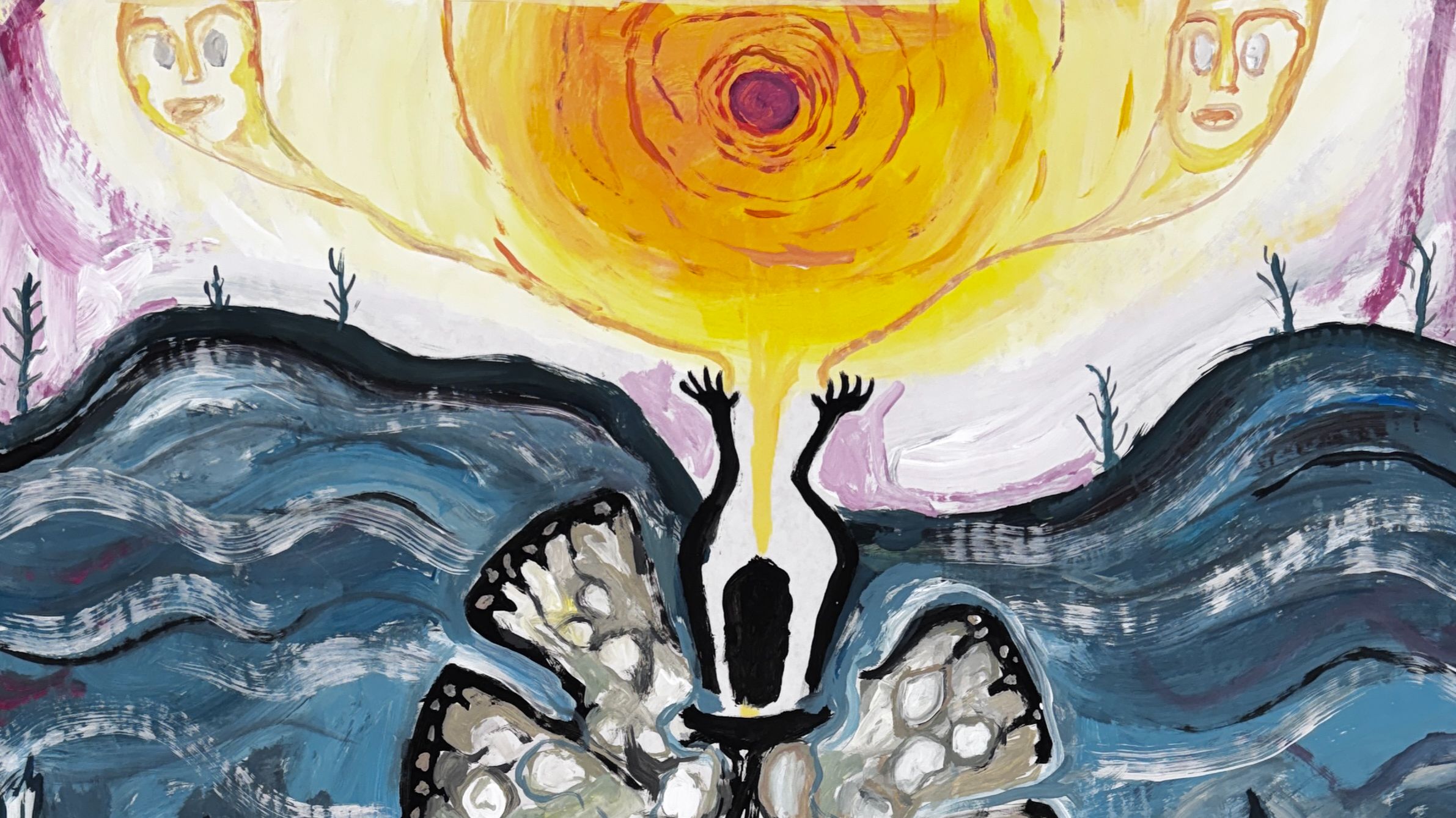
When material arises to us from the unconscious in the form of an image either through a creative process or in a dream, we might be tempted to analyze it. Understandably, we want to to know the meaning that these mysterious images carry. Yet, images arising from the unconscious, just like dreams, rarely reveal themselves fully, and if they did, they would not have the same effect on us.
From a Jungian perspective, the images we create can be approached as sacred expressions rising from the deepest parts of the Self. Something intimate and previously unseen has taken visible form. This makes the process both vulnerable and sensitive, and the image needs to be met with respect.
Rather than trying to capture its meaning, we can begin by remaining present with it. We can look, listen and allow a relationship to develop. The question isn't really “What does this image mean?” but rather “How can I enter into a dialogue with what has appeared?”
Circumambulating the Image
The word circumambulation means to walk or move around something sacred in a circular motion. It captures the way we can approach images very well. Instead of moving directly towards one final interpretation, we circle around the image like a spiral. We view it from different perspectives, return to it with new questions and notice how our relationship to it changes.
The process awakened through art-making does'nt end when the physical image is finished. An element that initially seemed unimportant may later become central. Often I've witnessed my clients having aspects of their images come into their dreams and vice versa. In this way, images can have a life of their own. They continue to live still partly in the unconscious and unfold over time.
This is why the work we do with images is best understood as a process rather than the production of a final object. It's a movement towards building a relationship with unconscious content. When this becomes the focus, the aesthetic quality of the artwork becomes secondary and the inner critic within us becomes more relaxed. Ultimately what matters is our curiosity and openness about what the image may have to tell us.
Begin with Your Immediate Response
When looking at an image a great place to start your reflection is with your spontaneous, unfiltered reaction. Note any immediate feelings and thoughts that you have, how your body is reacting to the image and if you sense any kind of gut feelings about it.
Focusing on an image in this way and giving attention to it, results in what Jung described as the "lowering of psychic energy". This requires that we are fully receptive to what is present in the image. Actually if you can really stay present to the image, the questions that you need to ask from the image will arise from the image itself and the message that the image carries will also emerge from the image itself. The key is to trust that there is inherent wisdom in the unconscious from which the image emerged and so the image knows more than we consciously do.
Stay Close to What Is Actually There
Having a dialogue with an image requires us to remain present with it. This sounds simple, but it's actually very easy to quickly move into explanations and associations. We might see a tree and immediately begin thinking about every symbolic meaning of trees, something we once read in a book or a memory from childhood. Associations can become valuable later, but if we move too far away too quickly, we may lose contact with this particular tree in this particular image.
Begin instead by describing what is actually present. What colors, shapes, figures, spaces and movements can you see? What appears central? Try to describe these things without explaining them. For example, “There is a small red figure standing beneath a large black shape” stays close to the image. “The red figure represents my wounded inner child beneath my oppressive father” may be a possibility, but it already moves into interpretation.
By first attending to what is visible, we give the image a chance to lead the reflection. This becomes increasingly easier the more we work with images and the more we are able to witness and therefore trust the inherent wisdom of the unconscious.
Giving Space for Imagination
It's important that we don't use only rational reflection when looking at an image. Rather than only thinking about the image from the outside, we can imagine entering its world. This is truly one of the best ways to open the door for the wisdom of the image to move us and often surprising things come through from an imaginative reflection.
What can you see, hear or feel when you imagine yourself entering the image? How does the "story" of the image move forward? You might return to a figure from your artwork in your imagination and wait to see whether it moves, speaks or changes. Ask who it is, why it has appeared or what it wants you to understand. If a figure in the image could talk, what would it say? What does it want? What does it need from you?
This is closely connected to Jung’s method of active imagination, in which we allow an image to develop without trying to control it and then consciously respond to what appears. The process is first receptive and then participatory: we observe and listen to the image without trying to control it, but we can also ask questions and take action within the image as ourselves.
So to use our previous example of an image where “There is a small red figure standing beneath a large black shape” we might picture ourselves entering the scene and ask the red figure how it feels beneath the black shape. Perhaps it says, “I feel small, but I am not afraid. I am waiting for enough space to move.” We might then ask the black shape what it wants. Instead of being threatening, it may answer, “I am trying to protect what is beneath me.”
Only after listening to the image in this imaginitive way can we begin to bridge it into our life. We might ask: Where in my life do I feel small or unable to move? Is there something that appears oppressive but may also be trying to protect me? What part of me is waiting for more space? In this way the image can then become a metaphor for a situation in our life and through the creative process we can then start to explore that specific situation with more depth.
Ask the Image Questions
Different images open up differently and there is no ABC-guidebook as to how each image should be approached. Sometimes nothing opens up in the image through an imaginative approach. If you feel stuck with an image, below are some possible questions that you might ask the image. To build a relationship with the unconscious we need to converse with it like we would do with a person we want to get closer to. By asking the image questions, we are approaching it with curiosity and allowing space for a response.
You might ask:
-
What is the general atmosphere or feeling tone of this image?
-
What questions arise from the image itself?
-
What felt important or central to me while creating it?
-
Where is the center of energy in the image?
- How do the different elements in the image relate to one another?
-
Where might this image originate from? In which direction is the image taking me?
- How are the elements of earth, water, air and fire present in the image?
- What is the image’s relationship to the feminine and the masculine energies?
- Are there polarities present? Are these opposites in conflict, separated from one another or beginning to form a relationship?
- What is the quintessence of the image? If everything unnecessary fell away, what essential quality would remain?
Recognizing Projection and Personal Bias
Whenever we encounter something unknown, we inevitably perceive it through our own history, expectations, wishes and fears. We tend to see what we are accustomed to seeing, what we expect to find or what we hope will be there. This makes it easy to project our own psyche into an image—especially when we are looking at an image created by someone else. Any reflection offered by another person should be held with healthy discernment. Someone might notice something that resonates with us, but they can't determine the truth of your image for you. Your own inner response remains central.
At the same time, we can also become attached to our personal interpretation. We might decide immediately that an image confirms what we already believe. A useful question in these moments is: What might be contrary to my assumption? If you believe a dark figure is threatening, could it also be protective? If you see an enclosed space as safe, could it also be confining? If an image seems entirely positive, what has been left outside it?
Asking what contradicts our first assumption helps us see a possibility that may still be unconscious. It takes into consideration the compensatory nature of images: the way the unconscious presents something that balances or challenges the conscious attitude. Our unconscious often shows up the opposite of our consciousness. It can also reveal our projections and help us retain healthy doubt. The aim is to remain open enough for the image to surprise us.
Working with images in a group can be particularly rich because no single personal bias has to take over. These responses can create a wider circle of perspectives around it helping us in the process of circumambulation. Through this variety, the person who created the image can begin to recognize more clearly what resonates as their own truth. In my online program, Unveiling the Unconscious, this respectful way of witnessing and reflecting on images is an important part of our process. The purpose is not to interpret one another from the outside, but to help each person deepen their own relationship with what has emerged. And while what others say can broaden our vision, we still have to always return to our own heart and inner knowing.
Let the Image Continue to Live
An image does not have to be understood in a single sitting. Place it somewhere you can return to it. Look at it again after a day, a week or several months. Notice whether your attention moves to a different element or whether its atmosphere has changed for you. You might notice connections with dreams, recurring symbols or changes taking place in your life.
The best way to understand the movements of the psyche is to keep a record of dreams and to make a series of images over a longer period of time. One image may be just a small glimpse into that magical world that lives in each of us. When we start to keep a record of our inner images and dreams we open ourselves to witness the deep mystery and well of wisdom that is available and present within us.
Ready to Go Deeper?
If you would like to explore this process in a guided group setting, I warmly invite you to join my online program.
Stay connected:
Join my mailing list to receive news and updates.