
Exploring Dream Elements Through Art
Aug 11, 2026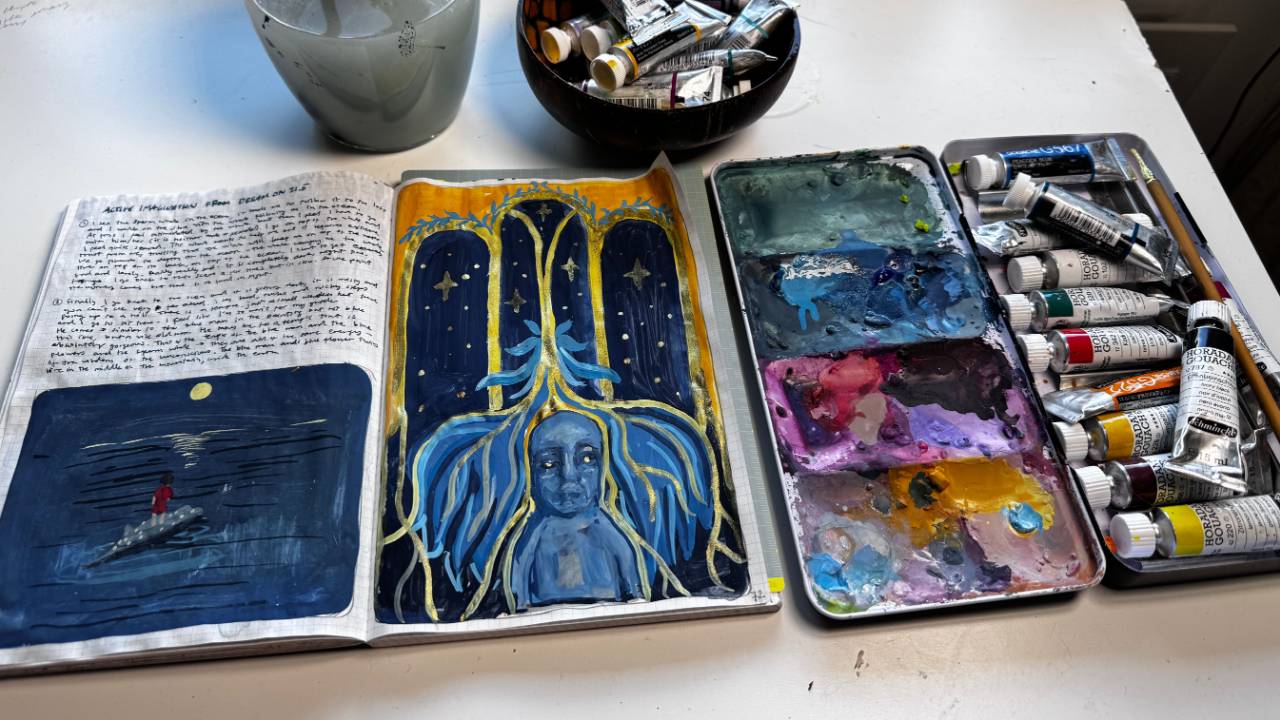
The Dream as an Inner Theatre
Jung saw dreams as a kind of theatre depicting what is happening in our psyche. He said, “A dream is a theatre in which the dreamer is himself the scene, the player, the prompter, the producer, the author, the public, and the critic.” What he meant by this is that we usually dream about ourselves and our inner world—the different aspects of ourselves that we may or may not be consciously aware of. The different elements in the dream provide us with different perspectives or facets of our inner world.
Because dreams usually tell us more about our inner world than our outer world, even when other people appear in our dreams, they are still pointing towards something about us and how we relate to them. When you dream of any person, place or object, your dreammaker has, for some reason, chosen that particular element to represent some characteristic of you. You could look at it as though the Dreammaker is holding up a mirror to show you something about yourself. It has chosen this particular element to reveal a specific aspect of you.
Jung said, “In each of us there is another whom we do not know. He speaks to us in dreams and tells us how differently he sees us from the way we see ourselves. When, therefore, we find ourselves in a difficult situation to which there is no solution, he can sometimes kindle a light that radically alters our attitude—the very attitude that led us into the difficult situation.”
Usually, when looking back at a dream, we tend to side with the dream ego. However, the dream ego is often the least trustworthy part. The dream may represent alternative viewpoints through its other figures and elements, but these are usually precisely the areas towards which we have a blind spot. That is why it can be very difficult to see our own dreams objectively. It is also why working with other people can be so helpful in understanding the dreammaker’s message, as they will not have the same blind spots. Of course, the dream ego’s perspective is not always wrong—there is never an “always” when it comes to dreams!
Approaching Different Dream Figures
When you begin looking at the different figures in your dream, start with the main character, who is often you—the dream ego. Consider the role your dream ego plays: Are you an observer or an active participant? Are you a victim, hero or persecutor? Perhaps you are a student or a teacher. The role we play in a dream is often similar to the one we play in our waking life. You might therefore consider the ways in which the role of the dream ego is carried into your waking life. The dream may also be challenging you to recognize that there could be problems with this role. You could consider how it may or may not be serving you in your waking life. This can bring you important information about how you see yourself or how you are approaching a particular situation.
It is also helpful to notice where the feelings are located in the dream. Is it the dream ego who is experiencing the emotions, or is it another figure? When a non-ego figure expresses a strong emotion, that figure can act as a kind of storage space for the dreammaker, from which the emotion can then be transferred into our consciousness.
If you notice that someone or something in the dream opposes the dream ego’s perspective, this is likely to be a compensation from the unconscious, guiding us towards greater balance. It is therefore important to question whether the figures and elements that initially seem bad or challenging—or that the dream ego regards as bad—might actually be bringing something valuable. What perspective are they bringing into the dream?
When you dream of another person, one way to explore their meaning is to consider their essential nature. You can begin by making a note of any key memories you have of this person. You might also consider how you are similar to them and how you are different.
We usually dream of friends, family members or people from our past. Sometimes, however, unknown or featureless people whom we do not recognize appear in our dreams. In that case, notice what feelings the person evokes. Do they remind you of anyone? If so, what associations do you have with that person? What traits does the unknown figure have, and how do you react to those traits? What do your imagination and intuition tell you about this person?
You might also dream of a celebrity or another famous person whom you do not know personally. In this case, consider what stands out to you most about this person’s work—perhaps it is a particular film, song or book. From there, you may begin to uncover what this person means within your dream.
Jung believed that, generally, when people of the same sex appear in dreams, they represent aspects of our shadow, while people of the opposite sex represent aspects of the anima or animus. We will explore the shadow, anima and animus more deeply in the lessons to come.
Sometimes the characters in our dreams are animals. When animals appear, there may be a heightened feeling associated with them. Animals can point us towards the sensory realm of our experience. They can also help us connect with parts of ourselves that we have forgotten or lost touch with. Sometimes animals appear as magical or numinous figures, or they may possess supernatural abilities. When an animal in a dream is accompanied by a feeling of awe, it can be an image of the Self, the centre of the psyche.
Sometimes characters in a dream speak or have a dialogue. In these cases, words spoken by the dream ego point towards our dominant ego attitude, while words spoken by non-ego elements are often direct statements from the Dreammaker. Jungian analyst Marie-Louise von Franz believed that we should pay particular attention to talking animals in dreams. They can reveal aspects of our personal shadow while also offering insight into the deeper wisdom of our instinctual nature.
Using Art to Work With Dream
Art is an especially powerful way to build this relationship with our inner symbols because we move from being passive viewers of the dream to becoming actively engaged with it. Through art, we can allow the symbolism of the dream to change and evolve. This process can help us move something within ourselves that might otherwise remain stuck.
The images you make may not exactly duplicate the dream, and that is not necessary. When we make an image of a dream, we allow the dream’s energy to move forward in some way, and this is an essential step. Jung believed that what is important about dreams is that they have a living effect on us. By making images of our dreams, we allow them to have this effect.
Art can help us make the relationships between different dream elements visible. When people, animals, places and objects are given their own visual form, we can begin to notice how they exist in relation to one another: which elements belong together, which require distance, and which occupy the centre or remain at the edges. We can also imaginatively enter the perspective of each element and explore how it experiences the dream, what it feels, and how it relates to the dream ego and the other elements. Some may support our familiar viewpoint, while others may oppose it or add something that consciousness has overlooked. Even an uncomfortable or seemingly insignificant element may carry something essential to the wholeness of the dream. By allowing these inner relationships to take visible form—and perhaps to shift or become more balanced through the creative process—we can gain a fuller sense of the inner situation the dream is revealing.
Dreaming the Dream Forward
To dream a dream forward means to continue, through imagination, the movement that the unconscious initiated through the dream. It is an act of being in reverence and dialogue with the dream’s symbolism. Rather than interpreting the dream once and then forgetting about it, we ask: What does this dream want to tell me? How can I remain in relationship with it?
Jung said, “Naturally a new meaning does not come ready-made out of the unconscious… a living effect is achieved only when the products of the unconscious are brought into serious relationship with the conscious mind.”
Dreaming a dream forward can be especially useful with nightmares and recurring dreams. Often, simply engaging with a dream in this way can open something within the unconscious, so that the dream either ceases altogether or changes in some way. Change does not necessarily require us to have intellectually understood the dream.
For Jung, the symbol was essentially alive; it was not a fixed structure. To become involved and engaged with living symbols meant gaining access to a symbolic life—and the symbolic life, in turn, was something he believed to be essential to living a life of meaning.
Ready to Go Deeper?
If you would like to explore this process in a guided group setting, I warmly invite you to join my online program.
Stay connected:
Join my mailing list to receive news and updates.